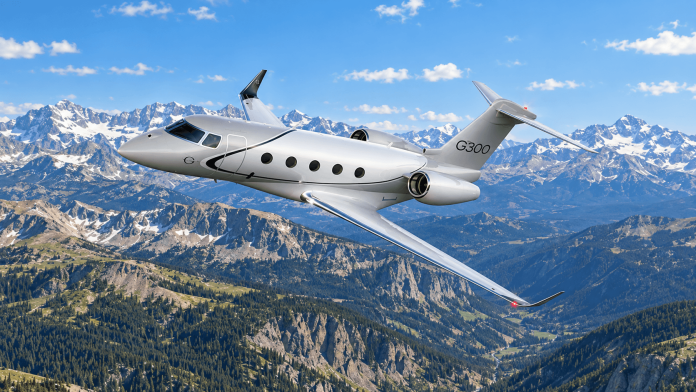
This Gulfstream G300 review examines an aircraft designed to bring a more modern cabin and cockpit to Gulfstream’s super-midsize lineup. Introduced on September 30, 2025, the G300 is the planned replacement for the G280, with updated avionics and the manufacturer’s signature panoramic oval windows. Its appeal starts with a familiar combination: substantial range, a comfortable cabin and the airport flexibility that makes a business jet useful beyond the major hubs.
The G300 completed its first flight in December 2025, beginning the flight-test phase of the program. Gulfstream continues to label its published performance figures as preliminary and subject to change. This review evaluates the announced specifications and equipment, rather than claiming flight experience or treating projected performance as an established operating record.
Where the Gulfstream G300 Fits
The G300 occupies the super-midsize end of Gulfstream’s lineup, below the larger G400 and the company’s longer-range aircraft. It serves buyers who want substantial traveling capability without purchasing an aircraft sized for frequent intercontinental missions. That makes it a different proposition from a G700 or G800, even though it shares the Gulfstream name.
For a business regularly flying across the United States, cabin comfort and airport access may matter more than having several thousand miles of unused range. Owners with occasional international trips may reach the same conclusion. The attraction is having enough aircraft for those journeys without moving into a larger category simply for the badge.
Its position puts it among familiar alternatives such as the Bombardier Challenger 3500, Cessna Citation Longitude and Embraer Praetor 600. Those aircraft deserve a detailed comparison of their own, particularly when it comes to cabin dimensions, payload and range assumptions. A ranking based only on maximum-range figures would miss several differences that matter in actual use.
Gulfstream G300 Review: Published Specifications
Gulfstream’s specifications provide a starting point for evaluating the aircraft. Both published range figures assume four passengers, two crew members and NBAA IFR reserves. Performance remains preliminary, while payload figures reflect a theoretical standard outfitting configuration.
| Specification | Gulfstream G300 |
|---|---|
| Aircraft category | Super-midsize business jet |
| Maximum published range | 3,600 nautical miles at Mach 0.80 |
| High-speed published range | 3,000 nautical miles at Mach 0.84 |
| Maximum operating speed | Mach 0.85 |
| Initial cruise altitude | 43,000 feet |
| Maximum cruise altitude | 45,000 feet |
| Published takeoff distance | 4,780 feet at sea level, ISA and maximum takeoff weight |
| Engines | Two Honeywell HTF7250G |
| Rated takeoff thrust | 7,624 pounds per engine |
| Flight deck | Gulfstream Harmony Flight Deck |
| Passenger seating | Up to 10 |
| Living areas | Two |
| Sleeping capacity | Up to five, depending on layout |
| Finished cabin height | 6 feet 1 inch |
| Finished cabin width | 6 feet 11 inches |
| Cabin length, excluding baggage | 27 feet 7 inches |
| Baggage volume | 120 cubic feet |
| Maximum payload | 3,820 pounds |
| Payload with full fuel | 900 pounds |
Range and Cruise Performance
The G300’s published range is 3,600 nautical miles at Mach 0.80. At the faster Mach 0.84 cruise setting, that figure falls to 3,000 nautical miles. Because both numbers use the same stated passenger, crew and reserve assumptions, they show the speed-versus-range tradeoff clearly.
That distinction becomes important on longer trips. Flying faster can shorten the airborne portion of a journey, but it also reduces the distance available before a fuel stop becomes necessary. Near the aircraft’s range limit, selecting a slower cruise speed could save more time overall if it allows the flight to remain nonstop.
The figures support Gulfstream’s positioning of the G300 as a transatlantic-capable aircraft. However, a range circle cannot guarantee a particular crossing under every combination of winds, loading and routing. Westbound headwinds and alternate-airport requirements can make the return journey a different calculation from the outbound flight.
Maximum operating speed also needs to remain separate from cruise performance. Mach 0.85 is the aircraft’s published operating limit, while Mach 0.80 and Mach 0.84 are the cruise settings associated with its range figures. Buyers should avoid reading the specifications as a promise of maximum speed and maximum range together.
Cabin Comfort and Passenger Space
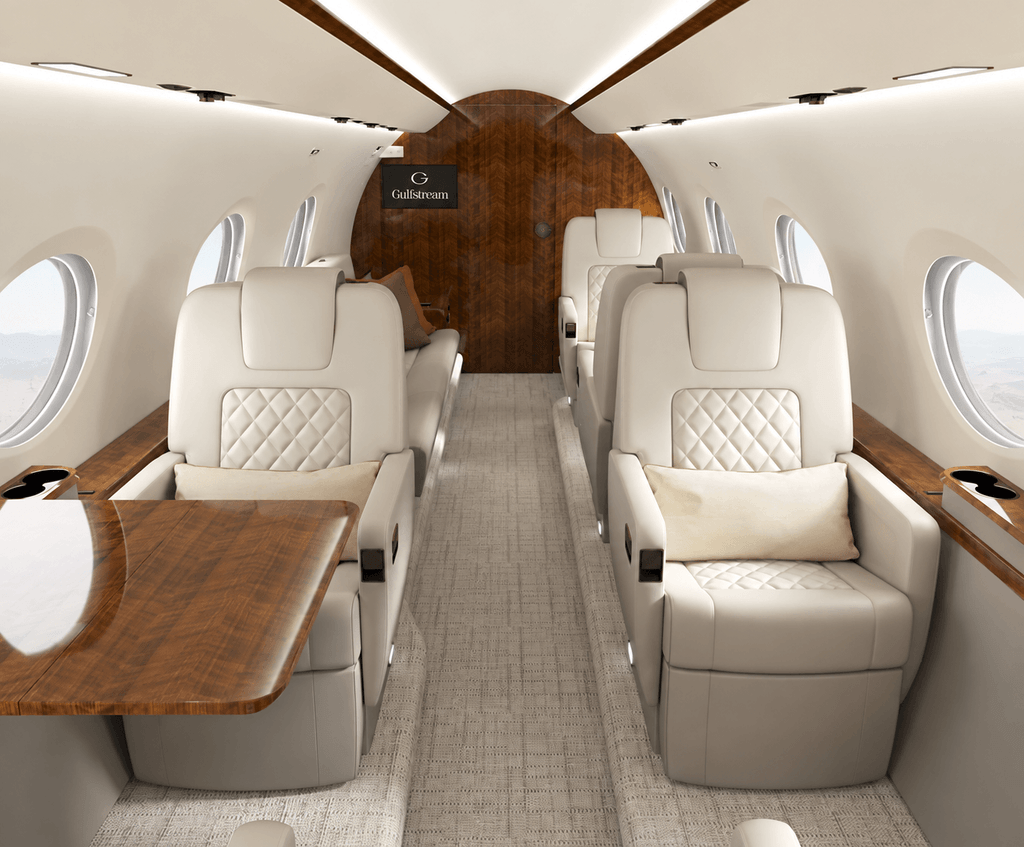
The cabin is one of the strongest reasons to pay attention to the G300. Gulfstream lists two living areas, seating for up to 10 passengers and sleeping arrangements for up to five, depending on configuration. Ten panoramic oval windows give the interior a recognizable Gulfstream appearance while bringing in natural light.
The published finished dimensions are 6 feet 1 inch in height and 6 feet 11 inches in width. Cabin length, excluding baggage, measures 27 feet 7 inches. Those dimensions give buyers a more useful picture of the space than the seating count alone.
An interior arranged for the largest passenger count may not be the best choice for a smaller group spending several hours aboard. Space to work, dine or rest can have more value than seats that rarely get used. The available layouts allow buyers to weigh those priorities before settling on a configuration.
Gulfstream also publishes a cabin altitude of 4,800 feet while the aircraft is flying at 41,000 feet. Its cabin air system uses outside air and plasma ionization technology. These features belong in the comfort discussion alongside seating, lighting and the overall interior layout.
The New Harmony Flight Deck
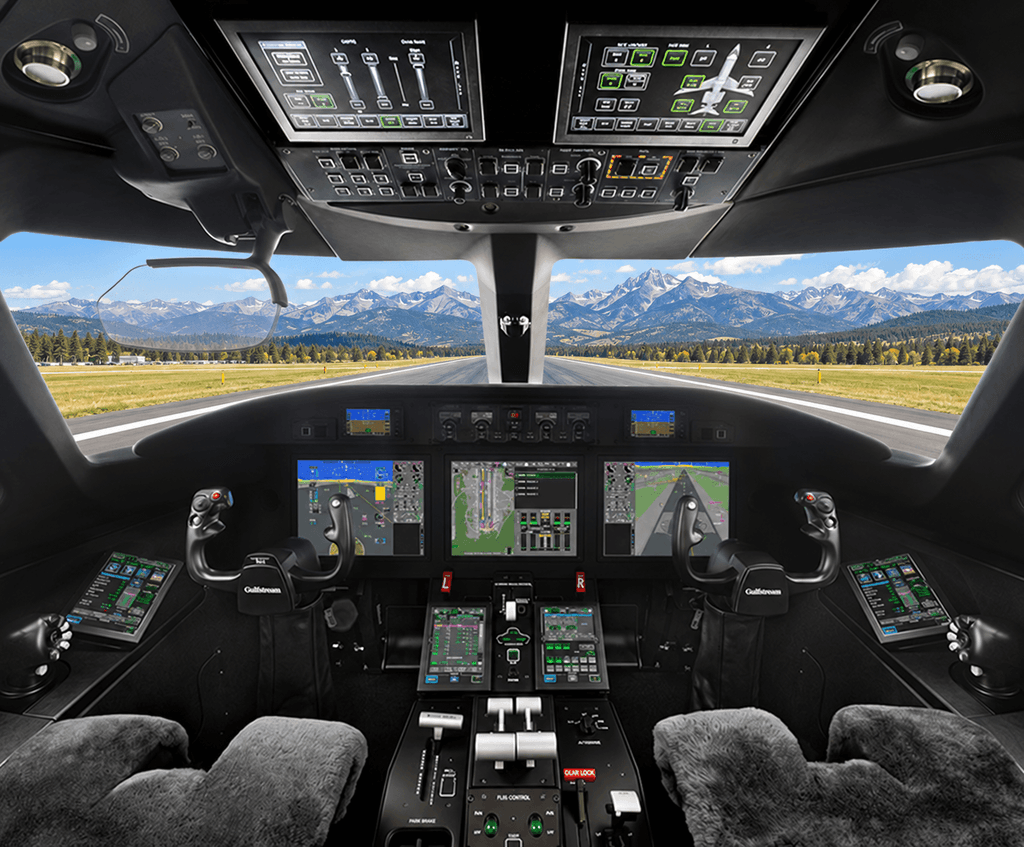
The G300 introduces Gulfstream’s Harmony Flight Deck, based on Honeywell Primus Epic 2.0 avionics. Gulfstream describes an interface with six touchscreens and Phase-of-Flight intelligence intended to streamline pilot workflow. The emphasis is on how crews access and manage information during different portions of a flight. For pilots, cockpit usefulness comes down to more than display size or touchscreen count. Clear information, sensible control placement and efficient procedures matter when a flight becomes demanding. Honeywell’s work on Harmony includes input from test pilots, engineers and human-factors specialists.
The announced safety features include a Synthetic Vision-Primary Flight Display and Gulfstream’s Predictive Landing Performance System. Synthetic vision presents a computer-generated view of terrain and runways. The landing-performance system dynamically displays a predicted runway stopping point to help crews recognize an overrun risk. Those tools address different situations. Synthetic vision helps crews understand the terrain and runway environment, while predicted stopping information draws attention to the space needed to complete a landing. Their value is in providing useful information early enough for the pilots to act.
Airport Access and Takeoff Performance
Gulfstream publishes a takeoff distance of 4,780 feet at sea level, standard atmospheric conditions and maximum takeoff weight. That is a defined performance case, rather than a blanket minimum runway requirement. Temperature, elevation, wind, runway condition and obstacles all affect the departure calculation.
Airport access has a direct influence on the convenience of private aviation. Landing closer to a customer, factory or second home can remove a lengthy drive from the journey. That benefit is easy to overlook when the conversation focuses entirely on cruise speed. The published takeoff figure suggests useful capability, but it needs to be applied carefully. Operators must calculate performance for the actual aircraft, departure weight and conditions. A runway that works comfortably on one trip may impose a restriction on another.
Payload Is the Number Buyers Should Watch
Gulfstream lists a maximum payload of 3,820 pounds, but payload with full fuel is 900 pounds under its standard-configuration assumptions. That is a substantial difference and one of the most important details in the specifications. Maximum passenger load and maximum fuel cannot be treated as though they are available simultaneously. On shorter flights, carrying less fuel can leave capacity for more passengers and baggage. Longer journeys require a closer look at how much load remains available after the necessary fuel is aboard. Interior options and installed equipment can also change an individual aircraft’s operating weight.
A realistic trip example becomes more useful here than a brochure comparison. Buyers should evaluate the passenger weights, baggage, destination and reserves that reflect their usual travel. A published 10-seat layout does not mean a fully occupied aircraft will achieve the advertised maximum range.
Would We Choose a Phenom 300E Instead?
We know the Phenom 300E well here at Elite Ace Aviation, so looking at the G300 raises a question: would we actually need this much airplane, or would a Phenom handle the trips we fly? They sit in different categories, but buyers do not always shop neatly within those boundaries. Sometimes the decision comes down to how much cabin and range they will regularly use. For shorter trips with a smaller passenger group, we would give the Phenom 300E serious consideration before moving into a super-midsize jet. The G300 becomes more compelling when longer flights and additional cabin space are regular requirements. Neither choice makes much sense without looking at the actual passenger load, baggage and destinations.
We have also reviewed the newly announced Phenom 300EV, which brings another option into that discussion for buyers planning ahead. Its upgrades deserve attention, although it remains a light jet and cannot replace the space offered by a larger aircraft. The question we would ask is simple: does the G300 solve a limitation we regularly face, or would we be buying capability we rarely use?
Is the G300 a Worthwhile Step Beyond the G280?
The G300’s clearest changes are its updated flight deck and cabin presentation. Gulfstream is bringing new cockpit tools and panoramic-window styling to the aircraft replacing the G280. Those improvements give buyers specific reasons to consider the newer model. For an existing G280 owner, the decision is more individual. New avionics and cabin features may be appealing, but their value depends on the current airplane’s condition, equipment and operating needs. An owner satisfied with an existing aircraft will need a stronger reason to change than a new model designation.
The G300 also needs time to build its own service history. Published specifications establish what Gulfstream intends the aircraft to accomplish. Dispatch reliability, maintenance experience and everyday operating results will become clearer as the program progresses and customer aircraft accumulate flight hours.
Gulfstream G300 Review Verdict
The G300 makes a credible case for buyers considering a new super-midsize jet. Its most appealing features are easy to identify: a spacious cabin, updated Harmony avionics and useful long-distance capability. The combination gives Gulfstream a more modern offering in a category where passengers expect comfort and flight crews expect capable equipment. Whether it justifies moving up from a G280 will depend on purchase price, final certified performance and operating experience. The full-fuel payload deserves particular attention, especially for owners who regularly combine longer flights with several passengers and baggage. Those are questions to resolve with realistic trip calculations rather than assumptions based on seating capacity.
On the information available so far, the G300 deserves a place on the shortlist. The cabin and cockpit changes are substantial enough to warrant a close look, while the published performance gives it the reach expected of a serious super-midsize aircraft. Final certification and service experience will show how well that package delivers.
Gulfstream G300 Frequently Asked Questions
Gulfstream publishes a range of 3,600 nautical miles at Mach 0.80 or 3,000 nautical miles at Mach 0.84. Both figures assume four passengers, two crew members and NBAA IFR reserves. These preliminary figures remain subject to change, and actual range depends on loading, weather, routing and aircraft configuration.
Gulfstream offers cabin layouts accommodating up to 10 passengers across two living areas. Depending on the selected interior, the aircraft can provide sleeping arrangements for up to five people. Available seating does not determine how many passengers can be carried on every flight, since fuel and payload limits also apply.
Yes, Gulfstream introduced the new G300 as the planned replacement for the G280. Its announced changes include the Harmony Flight Deck, updated cockpit technology and Gulfstream’s panoramic oval cabin windows.
Buyers should not assume it can. Gulfstream publishes a full-fuel payload of 900 pounds under its theoretical standard outfitting assumptions, which would generally be insufficient for 10 adults and their baggage. Carrying a larger passenger group would require a fuel-and-payload calculation for the individual aircraft and trip.
Related Aircraft Reviews
- Gulfstream G800 Review: Range, Performance and Cabin
- Embraer Phenom 300EV Review: Cockpit and Safety Upgrades
- HondaJet Echelon Review: Range, Specifications and Cabin