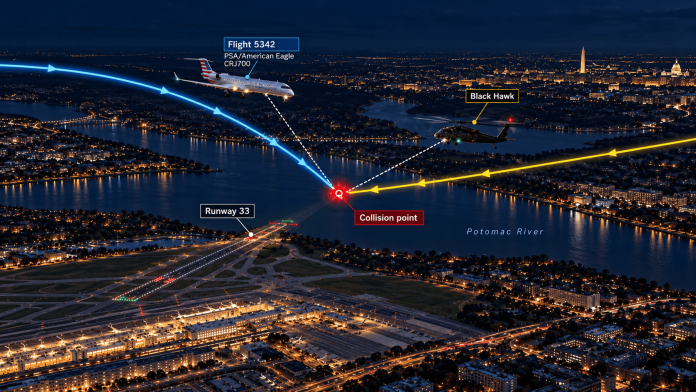
A newly disclosed U.S. Army report has added troubling details to the DCA midair collision investigation, identifying broken radio transmissions, technical problems with a Black Hawk helicopter, and shortcomings in pilot training requirements. The report, completed in May 2026 and obtained by news organizations on October 8, examines the January 29, 2025, collision near Ronald Reagan Washington National Airport that killed 67 people. Its findings largely reinforce earlier conclusions from the National Transportation Safety Board (NTSB), while providing additional insight into the Army’s role in the accident.
The collision involved American Airlines Flight 5342, a PSA Airlines-operated CRJ700 arriving from Wichita, Kansas, and a U.S. Army UH-60L Black Hawk helicopter conducting a training mission. The aircraft collided over the Potomac River at approximately 8:48 p.m., killing all 64 people aboard the regional jet and all three aboard the helicopter. This accident struck particularly close to home for me. A good friend of mine, who is also a pilot, had departed Reagan National just two or three minutes before the collision. We discussed the accident in considerable detail afterward, and knowing just how close his departure was to the tragedy has stayed with me as more information has emerged from the investigations.
Army Investigation Identifies Critical Communication Failures
One of the most significant findings in the Army’s report concerns two radio transmissions that the Black Hawk crew never fully received. According to investigators, these interrupted communications prevented the pilots from hearing information that could have helped them identify the approaching regional jet and understand its flight path. The first transmission involved an air traffic controller advising the helicopter crew that a CRJ was circling to land on Runway 33. The word “circling” was lost in the transmission, leaving the crew without an important detail about the airliner’s intended approach. A later instruction directing the helicopter to pass behind the CRJ was also partially blocked, this time by a microphone transmission originating inside the helicopter.
These interruptions occurred during the final moments of a flight through some of the country’s busiest and most complicated airspace. The helicopter pilots were also wearing night-vision goggles, which limited their field of view and made identifying the airliner against the surrounding city lights more difficult. The Army identified the interrupted communications as a particularly significant factor in the collision.
Black Hawk Altimeter Problems and Training Concerns
The Army’s investigation also identified technical issues involving the Black Hawk and a recurring pattern of helicopter crews failing to meet required semiannual flight-hour minimums. Those findings raise questions about how training requirements were monitored and enforced, particularly for crews operating around major commercial airports. Altitude was another important factor. The NTSB previously determined that the Black Hawk was flying above the maximum published altitude for its assigned helicopter route. Investigators found that the Army had not adequately informed pilots about the potential effects of barometric altimeter error tolerances, which could lead crews to believe they were operating at a different altitude than their actual position.
The NTSB also found shortcomings in the Army’s safety reporting and data collection practices. Previous altitude deviations and close encounters involving helicopters had not been adequately identified or evaluated, allowing potentially dangerous operating conditions to continue without sufficient corrective action.
NTSB Findings Point to Broader FAA Failures
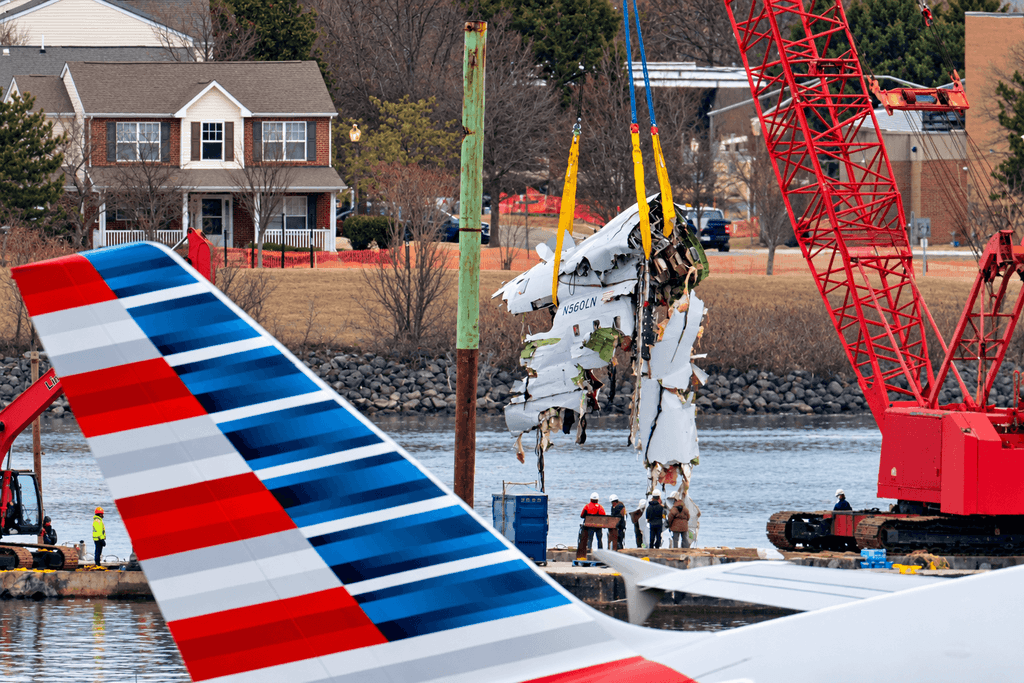
While the Army’s latest investigation concentrates on military operations, the NTSB’s earlier findings placed considerable responsibility on the Federal Aviation Administration (FAA). Federal investigators concluded that the helicopter route was positioned dangerously close to the approach path for Runway 33 at Reagan National Airport. Under certain operating conditions, an aircraft approaching Runway 33 and a helicopter flying along the published route could have as little as 75 feet of vertical separation. The NTSB determined that the FAA had failed to adequately review this risk despite previous warnings and evidence of close encounters between helicopters and commercial aircraft.
Air traffic control procedures were also scrutinized. At the time of the accident, a controller was handling both helicopter and local aircraft traffic, increasing workload during an already demanding period. Investigators found that the tower team lost situational awareness and failed to provide timely safety alerts that might have prevented the aircraft from converging. Another concern was the heavy reliance on visual separation, which placed responsibility on the helicopter crew to maintain a safe distance from the approaching CRJ. The NTSB determined that this approach did not adequately account for the limitations of identifying and tracking other aircraft at night, particularly when radio communication and traffic awareness were already compromised.
Aviation Safety Changes Following the Collision
The FAA has since introduced permanent restrictions on certain helicopter operations around Reagan National Airport, with limited exceptions for essential missions. The agency has also revised helicopter routes and implemented additional separation requirements intended to reduce conflicts between military helicopters and commercial aircraft. Collision avoidance technology remains another major area of concern. The NTSB determined that neither aircraft had a system capable of providing an effective warning of the impending collision in the circumstances of the accident. The findings have renewed attention on Automatic Dependent Surveillance-Broadcast (ADS-B) technology and the need for better traffic awareness when military and civilian aircraft share the same airspace.
Families of the victims continue to press Congress for additional aviation safety legislation. Both the House and Senate have advanced different versions of aviation safety measures, although lawmakers have not yet agreed on a final package. The Army is also reviewing helicopter operations in other metropolitan areas, including Los Angeles and the Seattle-Tacoma region, to determine whether similar hazards exist elsewhere.
What the Latest DCA Investigation Means for Aviation Safety
The Army’s findings make it increasingly difficult to attribute this collision to a single mistake. Investigators identified problems involving communication, altitude awareness, training, airspace design, and air traffic control. Each issue reduced the margin for error until the crews were left with almost no opportunity to avoid the collision.
For the aviation industry, the concern now extends beyond Reagan National Airport. Military and civilian aircraft routinely operate together near major airports throughout the country, and the lessons from this accident have implications for those operations as well. The investigations have identified what went wrong and where longstanding warning signs were missed. The real measure of their impact will be whether the changes now underway prevent another tragedy.
Related Aviation Articles & Safety Resources
Explore additional aviation coverage, official accident findings, and the safety changes introduced following the DCA collision.