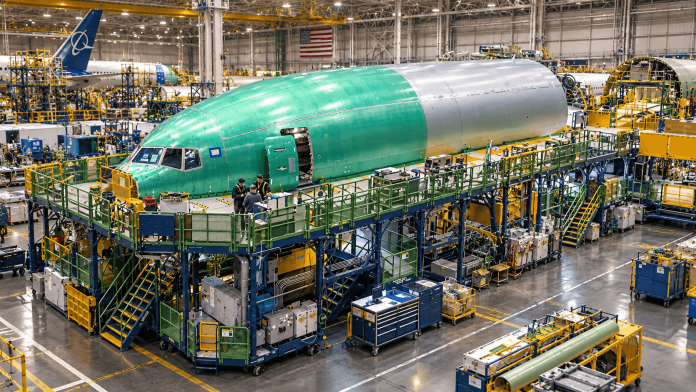
Boeing 777 freighter production has reportedly been at a standstill for nearly two months after a dispute with a Florida aerospace supplier interrupted deliveries of essential wing components. The shortage has also affected the company’s 767 manufacturing program, which supports both commercial freighters and the U.S. Air Force’s KC-46 Pegasus tanker. Although Boeing and the supplier reached a settlement in September, the disruption was still affecting production as of October 23, according to employees familiar with the situation.
The interruption comes as Boeing works to maintain production of its current-generation freighters while preparing for the transition to the 777-8F. It also highlights how dependent aircraft manufacturers can become on a single supplier, even for components that represent only a small part of a completed airplane.
How a Supplier Dispute Brought Wing Production to a Halt
At the center of the dispute is Vaero, a Florida aerospace supplier responsible for manufacturing trailing-edge rib kits used in Boeing’s 777 freighter and 767 aircraft. In August, Boeing filed a legal complaint alleging that Vaero had stopped supplying the parts, which the manufacturer described as essential to completing wing assemblies.
Trailing-edge ribs are structural components that support portions of an aircraft wing near its rear edge. They help maintain the wing’s shape and provide structural support for surrounding assemblies. Although these parts are relatively small compared with the completed wing, they must meet precise engineering and manufacturing requirements before installation.
Boeing identified Vaero as its sole supplier for the affected kits, leaving the company without an immediate alternative when deliveries stopped. According to Reuters, the shortage interrupted work at Boeing’s wing-production facility in Everett, Washington. In its legal filing, Boeing claimed the disruption could cost as much as $6.5 million per day, although that figure represents the company’s estimated exposure rather than a confirmed financial loss.
Why Production Has Not Returned to Normal
Boeing and Vaero reached a settlement in late September, but resolving the legal dispute did not immediately restore production. Three Boeing employees told Reuters that 777 freighter manufacturing remained halted as of October 23, nearly a month after the agreement. The shortage has already affected aircraft moving through final assembly. One employee said Boeing removed two partially assembled 777 freighters from the production line because their wings could not be completed. Reuters, citing aircraft data from aviation consultancy IBA, identified one of those aircraft as intended for FedEx.
Some components have reportedly reached the 767 production line since the settlement, allowing limited manufacturing work to continue. However, Boeing has not publicly confirmed when normal production will resume or how many customer deliveries could be affected. The company declined to comment on the interruption when contacted by Reuters, while Vaero did not respond to the news organization’s request for comment.
The Disruption Also Affects Boeing’s 767 and KC-46 Programs
The supplier shortage extends beyond the 777 because Boeing’s 767 program relies on components from the same manufacturing relationship. That program produces commercial freighters as well as the KC-46 Pegasus, the aerial refueling tanker operated by the U.S. Air Force. The KC-46 shares the underlying 767 airframe, meaning a disruption involving common structural components can affect both commercial and military manufacturing. Boeing’s third-quarter delivery figures provide a measure of the program’s activity, but they do not establish how many aircraft will experience delays because of the shortage.
For Boeing, the concern is not limited to the number of airplanes currently awaiting components. Extended interruptions can also complicate production scheduling, workforce assignments and the movement of aircraft through assembly facilities. Those problems become more difficult to manage when several aircraft programs depend on the same parts.
Boeing May Bring Component Manufacturing In-House
Boeing is reportedly working toward manufacturing the affected wing components internally rather than continuing to rely entirely on Vaero. Two employees familiar with the situation told Reuters about the effort, although the company has not publicly announced a timetable for the transition.
Establishing another production source involves more than obtaining the engineering drawings. Aircraft structural components require specialized tooling, controlled manufacturing processes, inspections and documentation showing that finished parts meet the approved design requirements. Depending on the arrangements, Boeing would also need to establish the necessary production capacity without creating additional delays elsewhere in its manufacturing system.
That helps explain why a supplier dispute can continue affecting aircraft production after the companies involved reach an agreement. Restarting a manufacturing process takes time, particularly when the components must meet demanding aerospace quality standards.
The Timing Matters for Boeing’s 777 Freighter Program
The production interruption comes during an important period for Boeing’s cargo aircraft business. The current-generation 777F remains a major long-range freighter, and Boeing is preparing to replace it with the newer 777-8F as part of the broader 777X family. In September, federal regulators granted Boeing an exemption allowing the company to obtain initial airworthiness certificates for up to 35 additional 777 freighters between January 2028 and January 2031. The exemption provides limited relief from emissions-related certification restrictions that otherwise would have affected production of newly manufactured 777Fs after 2027.
The approval gives Boeing more flexibility to continue supplying the existing freighter while the 777-8F progresses toward service entry. It does not represent 35 additional aircraft orders, and Boeing is not required to manufacture the full number permitted under the exemption. The 777F also remains commercially relevant because of its range, payload capability and established position in the global air cargo market. Aviation consultancy Cirium has reported continued demand for the aircraft, supported by its existing operator base and the limited availability of comparable new-production long-range freighters.
Why the Boeing 777X Is Not Affected
Despite sharing the 777 name, the newer 777X uses a substantially different wing design from the current-generation 777 freighter. Its large composite wings are manufactured through a separate production process and do not depend on the same trailing-edge rib kits involved in the Vaero dispute.
Employees cited by Reuters said the shortage has not affected 777X production. That distinction is important because Boeing is already managing a lengthy certification and development program for the newer aircraft family, and there is no evidence linking this particular supplier dispute to those challenges.
What Happens Next for Boeing and Its Customers?
The immediate question is how quickly Boeing can restore a reliable supply of the affected wing components. Aircraft that completed wing assembly before the shortage may still progress toward delivery, but those waiting for unfinished wings could face additional delays if production does not recover. Boeing has not released a revised delivery schedule or confirmed the number of aircraft affected. Until those details become available, the financial and operational consequences remain difficult to measure beyond the manufacturing interruption described by employees and in the company’s legal filing.
The longer-term issue is whether Boeing can reduce its dependence on sole-source suppliers for components that can stop an entire production line. Bringing the parts in-house could provide greater control, but the effectiveness of that approach will depend on how quickly Boeing can establish qualified manufacturing capacity and restore consistent output.