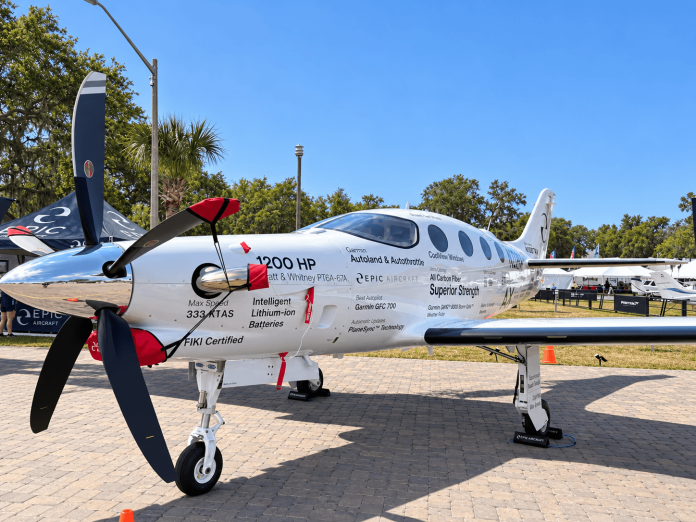
Epic E1000 AX Autoland has received FAA certification, giving the single-engine turboprop an emergency landing system that can take over if the pilot becomes incapacitated. Epic Aircraft announced the approval on September 30, 2026, after introducing the feature at Sun ’n Fun in April 2025. The system gives passengers a way to get the airplane on the ground without having to take the controls themselves.
The E1000 AX received its aircraft certification in 2025. This latest approval specifically covers Garmin Autoland, which required additional engineering, testing and certification before becoming an approved capability on the aircraft. Epic says that work is complete and the system is now cleared for installation on the AX.
How Epic E1000 AX Autoland Works
A passenger can activate Autoland by pressing a dedicated button. According to Epic, the system can also engage automatically when it determines that the pilot is incapacitated. Once activated, it selects a suitable airport and manages the flight through landing without requiring a passenger to fly the airplane. Choosing that airport involves more than locating the closest runway. The system considers distance, remaining fuel, weather, terrain and runway suitability before selecting a destination. An airport nearby might have an unsuitable runway or unfavorable conditions, making another location a better option.
As the aircraft heads toward its selected destination, Autoland communicates its intentions to air traffic control and keeps passengers informed. It then handles the approach and landing, bringing the airplane to a stop on the runway. Epic says the automated sequence also includes shutting down the engine without pilot input.
What Makes It Different From a Regular Autopilot?

An autopilot can handle much of the flying under a pilot’s direction. Depending on the equipment, it can maintain altitude, follow a programmed route and fly an instrument approach. The pilot still chooses the destination, manages the aircraft’s configuration and remains responsible for completing the flight. Emergency Autoland takes on a broader job when the pilot cannot continue. It coordinates destination selection, navigation, engine power, communications and landing. That distinction is especially important for a passenger who has never flown an airplane and would otherwise need help with unfamiliar controls.
The presence of an autopilot or a modern glass cockpit does not mean an aircraft has this capability. Emergency Autoland requires an approved installation that connects the equipment needed to carry out the entire sequence. In the E1000 AX, this certification brings that capability to an aircraft already designed around single-pilot operation.
What Passengers Experience During an Emergency Landing
For someone sitting in the cabin, understanding what happens after activation is almost as important as knowing where the button is. Garmin designed Autoland to communicate with passengers as it carries out the emergency flight. Occupants receive information about what the system is doing rather than being left to interpret unfamiliar flight instruments on their own. Automated radio transmissions also advise controllers and nearby pilots of the aircraft’s situation and intentions. A passenger does not have to make the initial emergency calls while trying to understand how to operate the airplane. The system handles those communications as it works toward the selected runway.
After landing, the aircraft stops on the runway so emergency personnel can reach the pilot and passengers. It does not continue taxiing toward a terminal or parking area. That is an important part of the sequence because getting medical assistance to the occupants may be the next priority. A preflight explanation still has value, particularly when passengers are unfamiliar with the aircraft. The pilot can show them the activation buttons and explain when the system should be used. That conversation is much easier to have on the ground than during an unexpected emergency.
Multiple Activation Buttons Throughout the Cabin
Epic has equipped the E1000 AX with multiple Autoland activation buttons throughout the cabin. The manufacturer says it is the only high-performance single-engine aircraft offering that arrangement. It gives passengers access to the system from more than one location inside the airplane. The placement has a practical benefit in an aircraft flown by a single pilot. Someone seated farther back may have difficulty reaching the cockpit, especially if the pilot needs immediate assistance. An accessible cabin button gives that passenger a direct way to initiate the emergency landing sequence.
This detail could easily get overlooked beside the aircraft’s speed and avionics specifications. However, the location of emergency equipment matters to the person who has to use it. Providing several activation points makes passenger access part of the design.
The E1000 AX Combines Speed With Single-Pilot Capability
The E1000 AX is a six-seat, pressurized turboprop built with a carbon-fiber composite airframe. Epic publishes a maximum cruise speed of 333 knots true airspeed and a normal cruise speed of 317 knots. Its maximum operating altitude is 34,000 feet, giving it substantial traveling capability for an aircraft in this category. Epic lists a maximum range of 1,560 nautical miles. Actual trip range depends on loading, winds, routing and fuel reserves, so owners need to evaluate those numbers against their usual missions. Maximum cruise speed and maximum range are also separate performance figures, rather than results to expect together on the same flight.
Power comes from a Pratt & Whitney PT6A-67A engine rated at 1,200 shaft horsepower, driving a five-blade Hartzell composite propeller. The cockpit features Garmin G1000 NXi avionics, and the AX also includes Garmin Autothrottle. These systems form part of an aircraft intended to make fast, single-pilot travel manageable.
Autothrottle controls engine power, which is necessary when an automated system must coordinate speed changes, climbs and descents. During an Autoland activation, power management works with the flight-control systems to carry out the emergency sequence. It is the coordination between those systems that allows the aircraft to proceed through approach and landing.
What the FAA Approval Means
The September 30 announcement confirms that Garmin Autoland is approved for the E1000 AX and cleared for installation. It does not establish that every previously delivered AX already has the system installed and activated. Owners of existing aircraft should confirm their airplane’s status and any required work directly with Epic.
Garmin specifies that Autoland is intended for emergency use and depends on the required aircraft systems remaining operational. Airport suitability and landing conditions still matter. The approval adds an emergency capability while leaving the pilot responsible for normal flight planning and operation. Epic E1000 AX Autoland addresses a specific concern for people traveling with one pilot: what they can do if that pilot suddenly becomes unable to fly. The aircraft’s speed, range and cabin determine how well it serves a trip, but this system gives passengers an option during an emergency they may have no training to handle. With FAA certification complete, that capability is now approved for the AX.
Related Articles
- Embraer Phenom 300EV Review: Performance, Cockpit and Safety Upgrades
- Phenom 300EV vs Citation CJ4 Gen2: Comparing Single-Pilot Light Jets